
Drug Treatment in Denver: A Complete Path to Recovery
Our commitment to comprehensive care extends to Denver, where Drug Treatment Denver represents a complete path to recovery built on a multi-disciplinary foundation. This journey integrates evidence-based therapies, medical oversight, and whole-person support, reflecting national guidelines for effective, individualized care.
A full recovery pathway begins with a thorough clinical assessment to identify the nature and severity of substance use, co-occurring mental health conditions, and personal strengths. We then blend core therapeutic modalities such as Cognitive Behavioral Therapy, Dialectical Behavior Therapy, and Acceptance and Commitment Therapy with structured medication management. Our approach includes dedicated Dual Diagnosis Treatment Denver to address co-occurring conditions simultaneously, because lasting recovery depends on healing the whole person. When clinically appropriate, we provide Medication Assisted Treatment Denver for withdrawal support and craving reduction, coordinated through integrated medical oversight. According to the Substance Abuse and Mental Health Services Administration, evidence-based practices form the essential backbone of effective substance use treatment, while state-level resources from the State of Colorado help ensure that treatment facilities meet rigorous licensing and quality standards.
This whole-person roadmap embodies our 360° CARE philosophy. Fidelity is hope and healing, and that belief drives every level of our coordinated continuum. This complete path is rooted in our Colorado mental health and addiction care, detailed next.
Levels of Care for Drug Treatment in Denver
Effective Drug Treatment Denver begins with understanding that recovery is a personalized journey requiring different intensities of support at different stages. When seeking addiction care in Denver, two of the most common structured programs are Partial Hospitalization Programs (PHP) and Intensive Outpatient Programs (IOP). These levels of care form the backbone of a coordinated continuum, and at Fidelity Behavioral Health, we help individuals and families determine which program aligns with their clinical needs and life circumstances. For a full continuum of care, explore our comprehensive mental health treatment Colorado offerings, which integrate mental health support with substance use recovery.
The following table compares the key features of PHP and IOP as they are commonly structured in Denver treatment centers. These distinctions are based on guidelines from the Substance Abuse and Mental Health Services Administration (SAMHSA) and the Colorado Department of Human Services (CDHS), which set standards for program hours, therapy types, and supervision levels.
Comparison of PHP vs IOP for Addiction Treatment FeaturePHP (Partial Hospitalization)IOP (Intensive Outpatient)
| Hours Per Week | Typically 25–35 hours spread over 5 days a week | Typically 9–12 hours over 3 days a week |
| Therapy Types | Group therapy + individual therapy + skills training | Group therapy + optional individual therapy |
| Supervision | Daily medical and clinical supervision | Regular but less intensive clinical oversight |
| Housing | Often includes supportive housing (e.g., PHP housing) | Patient lives at home or in sober living |
| Best For | Stabilization, step‑down from inpatient, high‑acuity needs | Step‑down from PHP, moderate needs, work/school schedule |
PHP is designed for individuals who require a high level of structure and daily clinical oversight, making it an ideal step-down from inpatient care or for those with high-acuity substance use disorders. With 25 to 35 hours of programming each week, PHP at Fidelity Behavioral Health includes group therapy, individual therapy, and skills training, alongside medication management when appropriate. For individuals with co-occurring conditions, Dual Diagnosis Treatment Denver addresses both substance use and mental health disorders within the same therapeutic framework.
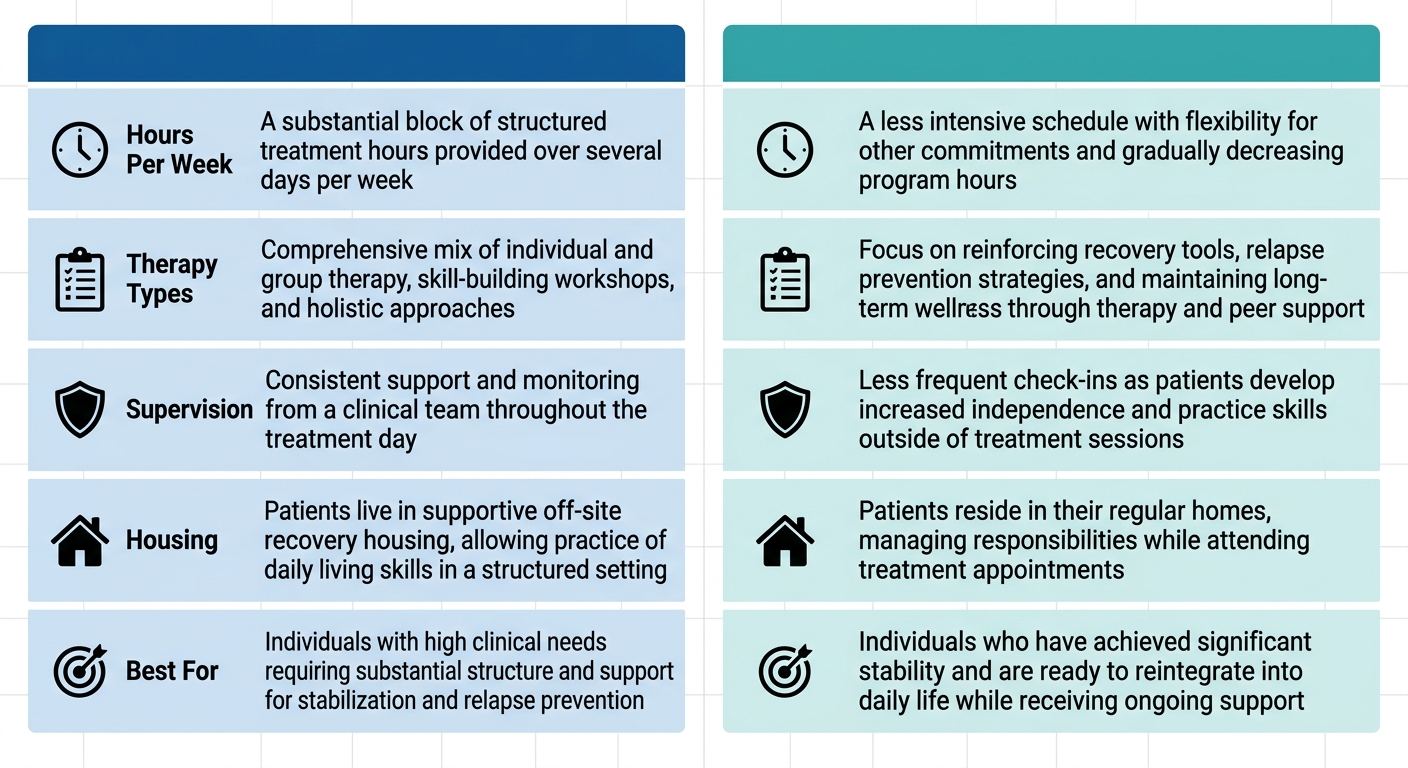
PHP and IOP levels of care comparison for Denver addiction treatment
IOP offers a more flexible treatment schedule, typically requiring 9 to 12 hours of programming over three days each week. This level of care allows participants to live at home or in a sober living environment while maintaining work, school, or family responsibilities. Our Denver IOP includes evidence-based therapies such as Cognitive Behavioral Therapy (CBT), Dialectical Behavior Therapy (DBT), and group processing, with optional individual therapy sessions. For those who benefit from pharmacological support, Medication Assisted Treatment Denver can be integrated into both PHP and IOP to manage cravings and support stabilization. Understanding these distinct levels of care empowers you to choose a starting point with confidence. The next section will guide you through what to expect when beginning treatment and how to take the first step toward lasting recovery. Results may vary based on individual patient circumstances.
Results may vary based on individual patient circumstances. Please consult a licensed healthcare professional for diagnosis and treatment recommendations.
Dual Diagnosis Treatment in Denver: Integrated Care for Co-Occurring Disorders
Mental health and substance use disorders frequently occur together, creating complex challenges that demand specialized care. According to the Substance Abuse and Mental Health Services Administration (SAMHSA), integrated treatment is necessary because treating only one condition often results in poorer outcomes for the other. Effective mental health addiction services Colorado requires a coordinated approach that addresses the whole person, not isolated symptoms. Building on this understanding, Denver treatment centers implement evidence-based integrated care models that treat both conditions simultaneously.
What Is Dual Diagnosis and Why It Matters
Dual diagnosis refers to the simultaneous occurrence of at least one mental health disorder and one substance use disorder. Common mental health conditions include depression, anxiety, PTSD, and bipolar disorder, while substance use disorders may involve alcohol, opioids, or stimulants. The Substance Abuse and Mental Health Services Administration (SAMHSA) emphasizes through its TIP 42 guidelines that integrated treatment—delivered by one cohesive team—produces significantly better outcomes than sequential or parallel care approaches where different providers treat each condition separately.
This matters because untreated co-occurring disorders can intensify each other, creating a cycle where mental health symptoms drive substance use and vice versa. Integrated dual diagnosis treatment in Denver breaks this cycle by addressing both conditions within a unified therapeutic framework, ensuring that progress in one area supports healing in the other. Without this coordinated approach, individuals face higher risks of relapse, hospitalization, and diminished quality of life.
Integrated Therapies for Co-Occurring Disorders
Denver treatment centers employ multiple evidence-based therapies that address both mental health and substance use simultaneously. Each modality targets different aspects of the dual diagnosis experience, and effective programs often combine several approaches based on individual needs.
The following table compares four therapies foundational to dual diagnosis treatment:
Therapies Effective for Co-Occurring Disorders TherapyPrimary FocusEvidence LevelCommon Applications
| CBT | Thought patterns and behaviors | Strong | Depression, anxiety, substance use disorders |
| DBT | Emotional regulation and interpersonal skills | Strong | Borderline personality disorder, substance use, self‑harm |
| ACT | Acceptance and commitment to values‑driven action | Moderate to Strong | Anxiety, depression, co‑occurring addiction |
| MI | Motivational enhancement and readiness to change | Strong | Substance use disorders, treatment engagement |
These therapeutic approaches, endorsed in SAMHSA’s TIP 42 guidelines for co-occurring disorder treatment, each address distinct dimensions of dual diagnosis. Cognitive Behavioral Therapy targets thought patterns and behaviors that maintain both conditions, while Dialectical Behavior Therapy focuses on emotional regulation and interpersonal skills essential for sustainable recovery. Acceptance and Commitment Therapy emphasizes aligning actions with personal values, and Motivational Interviewing enhances readiness to engage fully in the treatment process.
How Denver Centers Treat Mental Health and Addiction Simultaneously
With these therapies proven effective, Denver centers deploy them in coordinated treatment plans built on the same-team approach. Clinicians—including therapists, psychiatrists, and nurses—collaborate on a single treatment plan that addresses both conditions concurrently rather than treating them as separate issues. This means one team evaluates all symptoms, designs integrated interventions, and adjusts care based on the individual’s overall progress, not just how they’re doing with one diagnosis. Colorado integrated treatment standards developed in collaboration with the Department of Health Care Policy and Financing (HCPF) reinforce this model by emphasizing continuity and provider communication.
Medication management forms an important component of integrated care. Depending on individual needs, this may include antidepressants, mood stabilizers, or Medication Assisted Treatment in Denver using medications such as buprenorphine and naltrexone for opioid or alcohol use disorders. The same prescribing team monitors how psychiatric and addiction medications interact, ensuring the medication plan supports recovery from both conditions rather than introducing conflicts.
Our approach to drug treatment in Denver reflects this integrated philosophy. Fidelity is hope and healing. We provide Mental Health + Addiction Care within a framework we call 360° CARE, ensuring that every aspect of an individual’s well-being receives clinical attention. This is what human-centered care looks like—coordinated, comprehensive, and built for durable recovery.
Insurance and Access for Dual Diagnosis Care
Understanding coverage is the first step toward accessing effective treatment. Most private insurance plans, Colorado Medicaid (Health First Colorado), and Medicare provide coverage for dual diagnosis services, including therapy, medication management, and structured programming. According to the Colorado Department of Health Care Policy and Financing (HCPF), Health First Colorado programs serve more than a million Coloradans and support behavioral health services across the continuum of care, from outpatient to residential treatment.
Coverage details vary by plan, and individuals should verify benefits directly with the treatment center. Our team can assist with benefit verification, explaining what services fall under mental health benefits versus substance use benefits and how integrated dual diagnosis treatment is authorized. The HCPF also publishes policy transmittals and FAQs that beneficiaries can reference when navigating their coverage options.
Results may vary based on individual patient circumstances. Please consult a licensed healthcare professional for diagnosis and treatment recommendations.
Choosing the Right Drug Treatment Center in Denver
Once you understand the types of programs available, the next step is choosing the right center. Selecting a program for drug treatment in Denver is a significant decision, and careful evaluation can help you find a program that matches your clinical needs and personal recovery goals.
Assessing Your Treatment Needs
Before reaching out to providers, take time to reflect on your specific situation. A clear self-assessment helps you communicate effectively with admissions teams and identify programs equipped to support you.
Consider the following factors:
- Severity of Substance Use: Reflect on the duration and intensity of your substance use, and whether there is a physical dependence component.
- Co-occurring Mental Health Conditions: If you experience depression, anxiety, or other psychiatric symptoms, look for a program specializing in dual diagnosis treatment in Denver.
- Lifestyle Responsibilities: Evaluate your work, school, and family obligations to determine whether a structured day program like PHP or a more flexible IOP schedule is appropriate.
- Recovery Goals: Define whether your aim is complete abstinence, harm reduction, or stabilization on medication. Verify that prospective centers support your goals, including, if relevant, medication assisted treatment in Denver.
When evaluating centers, prioritize those that provide evidence-based mental health treatment Colorado residents can rely on for lasting recovery.
Questions to Ask When Evaluating a Treatment Center
During initial calls with treatment centers, ask specific, detailed questions to assess their quality and suitability. A reputable center will welcome your inquiries and provide transparent answers.
Key questions include:
- Is the center accredited by CARF or The Joint Commission, and does it hold a current state license?
- Are staff members licensed, such as LPC, LCSW, or LMFT, and are medical directors certified in addiction medicine?
- Do they offer evidence-based therapies like CBT, DBT, MI, and trauma-informed care?
- Is there a full continuum of care from PHP to IOP to outpatient, and what aftercare planning and alumni support are provided?
Key Factors to Compare When Choosing a Denver Drug Treatment Center FactorWhy It MattersWhat to Look For
| Accreditation | Ensures quality and safety | CARF, Joint Commission, state licensing |
| Treatment Approaches | Determines fit for your conditions | Evidence-based therapies (CBT, DBT, MI, trauma-informed) |
| Staff Credentials | Expertise affects outcomes | Licensed therapists, medical directors, peer support specialists |
| Continuum of Care | Support through every recovery stage | PHP, IOP, outpatient, case management, aftercare |
| Insurance Accepted | Affects affordability and access | Contact center to verify specific plans |
According to the Substance Abuse and Mental Health Services Administration (SAMHSA), accreditation by organizations like CARF or The Joint Commission signals that a facility meets nationally recognized standards for care. The State of Colorado provides additional regulatory information and behavioral health resources through its official web portal. Understanding these benchmarks empowers you to make an informed choice.
Verifying Insurance Coverage for Drug Treatment in Denver
Financial considerations are a practical part of the admission process. While specific costs are not discussed here, you can take proactive steps to clarify coverage before enrolling in drug treatment in Denver.
Follow these steps to verify your benefits:
- Call the member services number on the back of your insurance card.
- Ask specifically about coverage for Partial Hospitalization Program and Intensive Outpatient Program levels of care, and request a written benefits breakdown.
- Use the treatment center’s verification of benefits service, which can often get answers more quickly.
- Clarify how many days or sessions are covered and whether pre-authorization is required.
Preparing for Your Program Start
Once you have selected a center and verified coverage, several practical steps will ensure a smooth transition into treatment.
Here is what to prepare:
- Complete all intake assessments, including a clinical interview and any required screening.
- Arrange housing if you do not live near the program, noting that supportive housing options exist for PHP clients.
- Gather essential documents, such as a valid identification card and your insurance card.
- Notify your employer as appropriate and set up a personal support system with family, a sponsor, or a therapist.
After you select a center, the next section outlines what to expect during treatment. At Fidelity Behavioral Health, we believe choosing the right care is the first step toward hope and healing. Please consult a licensed healthcare professional for diagnosis and treatment recommendations. Results may vary based on individual patient circumstances.
Medication-Assisted Treatment in Denver: Evidence-Based Recovery Support
When searching for effective Drug Treatment Denver residents often encounter medication-assisted treatment (MAT) as a leading, evidence-based option. MAT combines FDA-approved medications with counseling and behavioral therapies to treat opioid use disorder. Our mental health programs Colorado integrate medication-assisted treatment Denver with comprehensive behavioral health support, underscoring our commitment to compassionate, human-centered care.
The following table provides an overview of the three FDA-approved medications commonly used in MAT for opioid recovery.
FDA-Approved Medications for Opioid Recovery MedicationMechanismAdministration
| Methadone | Full opioid agonist | Daily at certified clinics |
| Buprenorphine | Partial opioid agonist | Office-based prescription |
| Naltrexone | Opioid antagonist | Monthly injection |
Sources: SAMHSA Medication-Assisted Treatment (MAT) Guidelines and CDHS Colorado MAT Standards.
Each medication operates through a distinct mechanism but shares the common goal of stabilizing brain chemistry, reducing cravings, and blocking the euphoric effects of opioids. At Fidelity Behavioral Health, we ensure that all MAT protocols are delivered under rigorous medical supervision, tailored to individual needs within our broader continuum of care. Access to these evidence-based options in Denver means individuals can find a regimen that fits their recovery journey and lifestyle, from daily clinic visits to monthly injections.
Methadone, a full opioid agonist, has been a cornerstone of opioid treatment for decades. It requires daily administration at a certified opioid treatment program, offering a structured, monitored environment. Buprenorphine, a partial agonist, offers greater flexibility, as it can be prescribed by waivered providers in an office-based setting, making it a more accessible option for many. Naltrexone is a non-opioid antagonist available as a long-acting monthly injection, but it necessitates a complete detoxification from opioids before initiation to prevent severe withdrawal.
We recognize that medication is just one component of effective recovery. Dual diagnosis treatment Denver is often essential, as many individuals with opioid use disorder also have co-occurring mental health conditions. Our team weaves MAT together with individual and group therapy, case management, and primary care coordination to help each person build a durable foundation for a healthier life.
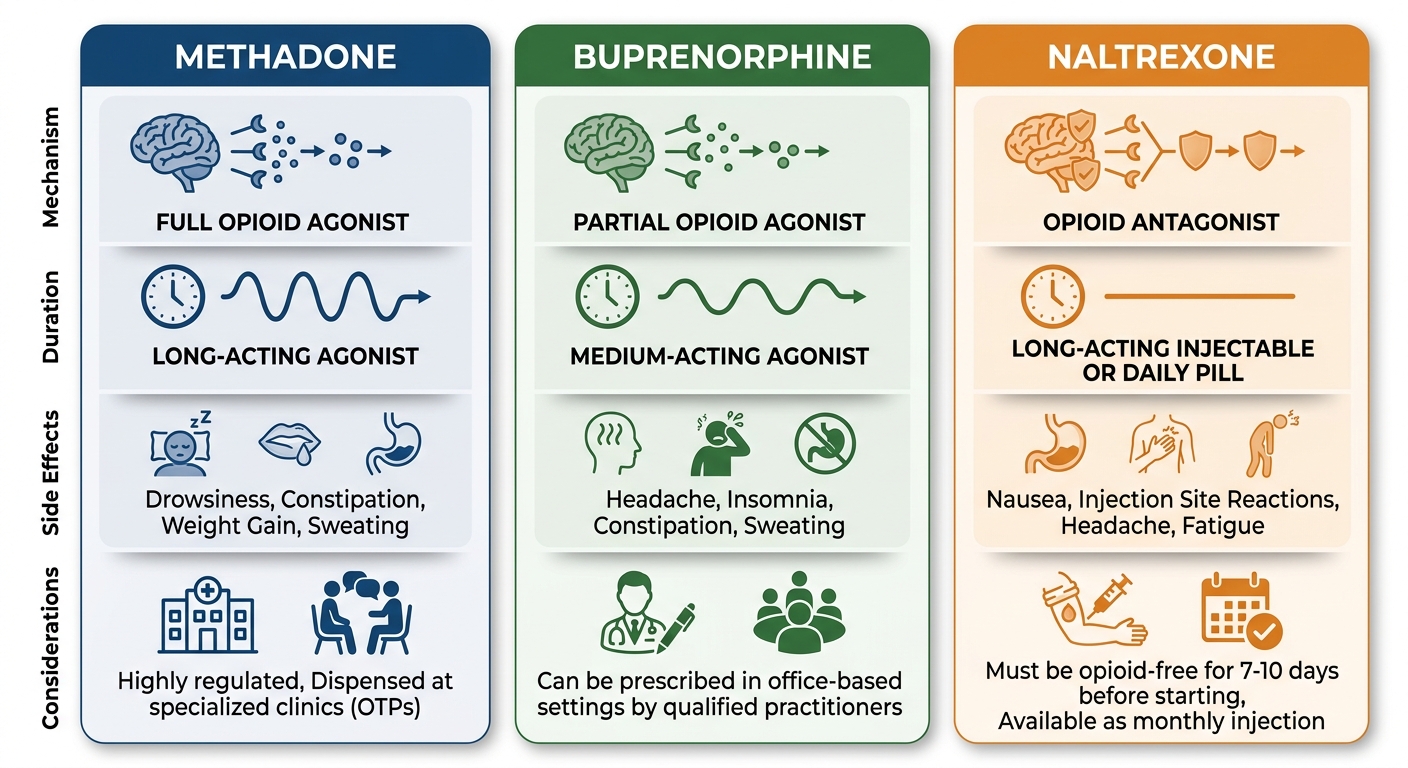
FDA-approved medication comparison for opioid recovery support
According to SAMHSA guidelines, MAT has been shown to reduce illicit opioid use, decrease overdose deaths, and improve treatment retention. The Colorado Department of Human Services endorses standards that support the integration of these medications within comprehensive treatment programs. We follow these federal and state guidelines to deliver safe, effective care. This is what human-centered care looks like—a whole-person approach that honors each person’s unique path to recovery. Results may vary based on individual patient circumstances. Please consult a licensed healthcare professional for diagnosis and treatment recommendations.
Frequently Asked Questions About Drug Treatment in Denver
Still have questions? Here are answers to the most common ones we hear about our Denver-based recovery programs.
What drug treatment options are available in Denver?
We offer a full continuum of care including Partial Hospitalization Program (PHP), Intensive Outpatient Program (IOP), and Medication-Assisted Treatment (MAT). The appropriate level of drug treatment Denver depends on a thorough clinical assessment, not patient preference. Our programs are licensed by the Colorado Department of Health Care Policy and Financing and follow federal best-practice guidelines established by SAMHSA.
Does Fidelity Behavioral Health accept insurance for treatment?
Yes, we work with major Colorado insurers and offer self-pay options. For a confidential benefits verification, please contact our admissions team directly.
What is Medication-Assisted Treatment and is it offered?
MAT combines FDA-approved medications with behavioral therapy to treat substance use disorders. Our Medication Assisted Treatment Denver integrates medication into a comprehensive care plan and is never offered as a standalone service.
How are co-occurring mental health conditions treated?
We operate under a dual diagnosis model, treating substance use and mental health conditions treated Colorado simultaneously. Conditions like depression and anxiety are addressed alongside addiction to support whole-person recovery. Results may vary based on individual patient circumstances.
How long does a typical treatment program last?
Program duration typically ranges from 4 to 12 weeks depending on individual progress and insurance coverage. Recovery is a personal process supported by evidence-based care, not an absolute cure.
Is housing provided during treatment?
Supportive housing is available for PHP clients, helping remove barriers to sustained engagement in substance use treatment in the Denver area.
Contact our admissions team for a confidential assessment and to verify insurance benefits.
Starting Your Recovery Journey in Denver
Beginning Drug Treatment Denver is an act of courage—a powerful decision to move toward a healthier, more hopeful future. We believe that every person deserves compassionate, human-centered care from the very first step.
The Denver recovery landscape is built around you. Whether you are exploring substance use treatment in Denver for the first time or have been on this path before, your journey will be unique. Recovery programs in Denver increasingly recognize that no two paths look exactly alike, which is why person-centered approaches sit at the heart of effective care.
For many, addressing underlying conditions is an essence part of healing, and Dual Diagnosis Treatment Denver reflects how integrated care can honor the whole person. Comprehensive options such as Medication Assisted Treatment Denver further support stability and comfort along the way.
At its core, starting your recovery journey in Denver is about hope and healing. As we explore the path forward, Denver offers a full spectrum of care designed around you.